
In 2025, my scholarly work was guided by a clear commitment to research as intellectual intervention rather than mere publication output. Positioned within a post-positivist paradigm, my research rejects value-neutral accounts of digital economies and instead foregrounds power and inequality. Across my publications, I sought to produce knowledge that is theoretically rigorous, empirically grounded, and socially consequential: particularly in relation to labor precarity and platform capitalism in the Global South.
Key Scholarly Contributions
My 2025 research makes three principal contributions.
- First, it advances a critical political economy of platform capitalism by demonstrating how labor flexibility is systematically transformed into cheap labour regimes.
- Second, it reconceptualizes algorithmic management not only as a technology of control but as a contested terrain, highlighting everyday forms of worker resistance and agency within digital labor systems.
- Third, it offers a theoretical critique of depoliticizing narratives (notably techno-feudalism) by re-centering capital accumulation, labor relations, and class power as the core dynamics of contemporary digital economies.
Book
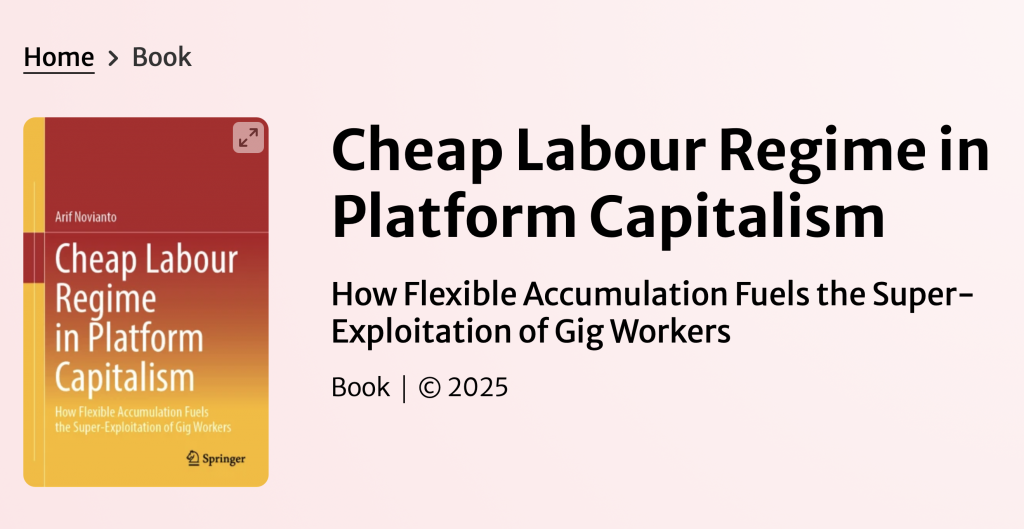
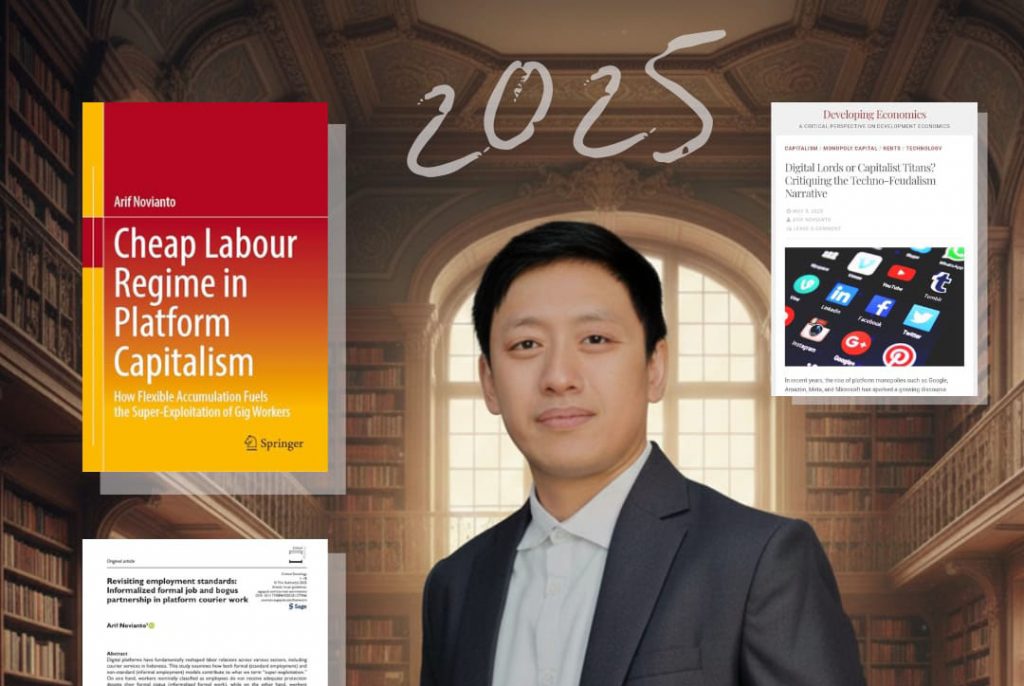
- Cheap Labour Regime in Platform Capitalism: How Flexible Accumulation Fuels the Super-Exploitation of Gig Workers (Springer, 2025) – Download PDF (1-13 pages)
Journal Article
- Gamification from Below as a Form of Resistance: Algorithmic Control, Precarity, and Resistance Dynamics of Indonesian Gig Workers (New Technology, Work and Employment, 2025) – Download PDF
- Revisiting Employment Standards: Informalised Formal Jobs and Bogus Partnership in Platform Courier Work (Critical Sociology, 2025) – Download PDF
Article
- Digital Lords or Capitalist Titans? Critiquing the Techno-Feudalism Narrative (Developing Economies, 2025) – Download PDF
Overall, my work in 2025 reflects a deliberate scholarly orientation: quality over volume, critique over compliance, and integrity over metrics. Writing is treated not as an administrative obligation, but as a form of responsibility: aimed at informing debate, shaping policy discourse, and contributing to more just futures of work in the digital economy.