Submit at: s.id/SubmitAIRegime · arifnovianto@untidar.ac.id
Introduction
The governance of work has never been left to chance. From the earliest configurations of industrial capitalism, the project of extracting maximum labour effort at minimum cost has been the central preoccupation of management as both practice and discipline. Understanding the “AI Regime of Work” that characterizes the contemporary platform economy requires situating it within this longer history — not as a radical rupture but as the latest configuration in an unbroken trajectory of capitalist effort to subordinate living labour to the requirements of accumulation.
Taylorism established the foundational logic: that management must possess complete knowledge of the labour process, wrested from workers through time-and-motion studies and task decomposition, in order to direct and discipline (Braverman, 1974; Taylor, 1911). The stopwatch was, in this sense, the first algorithmic tool — an instrument for converting human labour into calculable, manipulable data. Fordism institutionalized this logic through the assembly line while simultaneously producing a class compromise: stable employment, rising wages, and social insurance in exchange for productivity (Aglietta, 1979; Lipietz, 1987). The subsequent crisis of Fordism and the rise of post-Fordism dissolved this compromise, replacing stable employment with contingent, flexible work and direct managerial control with the disciplinary function of labour market insecurity — in what Faraoun (2024) characterizes as “unprecedented levels of labour market flexibilization along with an intensified crisis of social reproduction.”
Platformization constitutes the latest phase of this sequence, and the most consequential. Regulation school scholars have identified the platform economy as a new accumulation regime whose novelty lies in the role of digital infrastructures in facilitating the organization of capital along monopolistically controlled networks and the extraction of surplus through algorithmic, data-driven control of labour (Faraoun, 2024; Törnberg, 2023). From Taylor’s stopwatch to Ford’s assembly line to the post-Fordist performance target to the platform’s real-time GPS tracker, labour control has always required the conversion of human activity into calculable data. The digital platform has realized this project more completely than any prior technology of management.
I. Algorithmic Management and AI: A Necessary Distinction
Before theorizing the “AI Regime of Work,” two frequently conflated concepts must be distinguished: algorithmic management and artificial intelligence. The conflation is not innocent — it allows platforms to mystify governance practices as “AI-driven,” implying technical neutrality while obscuring the class interests embedded in their design.
An algorithm is a sequence of instructions programmed to complete a task or solve a problem (ILO, 2022). Many of the key features of algorithmic management long predate the digital revolution; the function of planning in management (setting rules for deciding in advance) is analogous to the design of algorithms. Artificial intelligence, by contrast, refers to systems capable of learning from data and adapting their outputs without explicit reprogramming, drawing on machine learning and, increasingly, deep learning. Crucially, currently existing AI is “narrow” rather than “general”: it requires human input to specify parameters and feed data; even the most advanced models on digital labour platforms remain cases of “conditional automation” requiring intensive human intervention for design, maintenance, and exception-handling (ILO, 2022).
The critical distinction is this: algorithmic management is the broader category — the use of computer-programmed procedures to organize, assign, monitor, supervise, and evaluate work (Baiocco et al., 2022). AI is a specific and expanding subset — those systems that employ machine learning to dynamically update their decision logic on the basis of accumulating data. The justification for speaking of an “AI Regime of Work” rather than simply “algorithmic management” is that AI-enhanced systems are now increasingly integrated into platform labour governance at scale: dynamic pricing learns from historical demand; deactivation systems adapt to workers’ workaround strategies; rating systems update their weighting in response to market conditions. This integration intensifies the opacity that is already characteristic of simpler algorithmic systems — algorithmic opacity can be employed as a control mechanism to maximize organizational objectives, and research shows how gig platforms withhold information about how algorithms operate to maintain soft control of the workforce (Jarrahi et al., 2021).
Five Functions of Algorithmic Management (Kellogg et al., 2020)
Task allocation in real time
Continuous evaluation through ratings and behavioural metrics
Direction through nudging, restricting, and recommending
Discipline through automated penalties and deactivation
Datafication — the capture, ownership, and monetization of behavioural and geospatial data workers generate, feeding back into algorithmic refinement while remaining inaccessible to workers
II. The AI Regime of Work and the Cheap Labour Regime
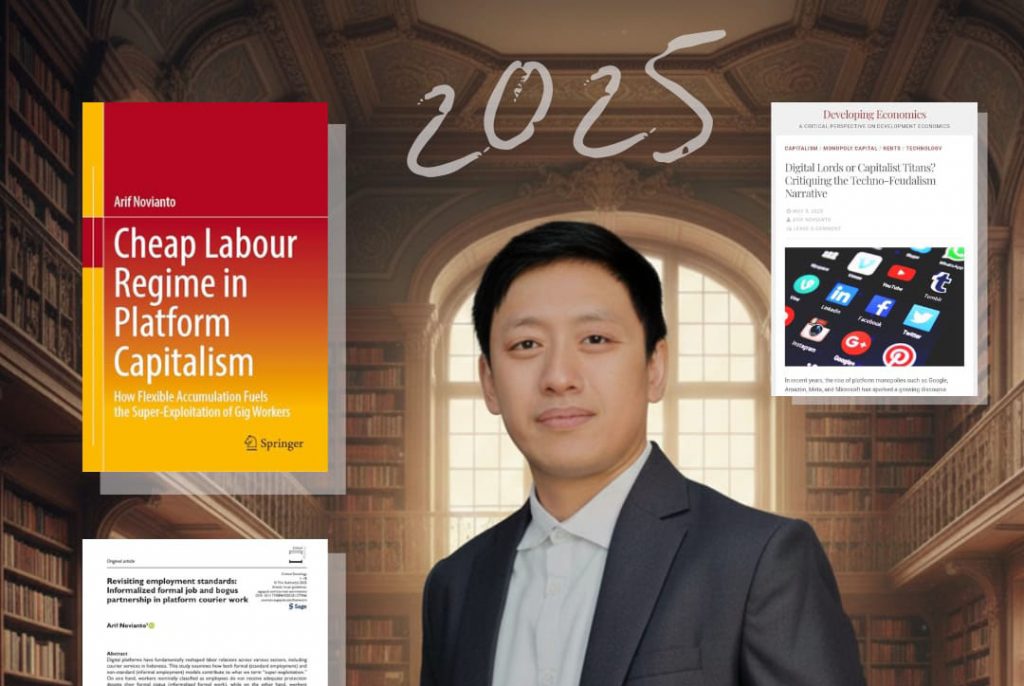
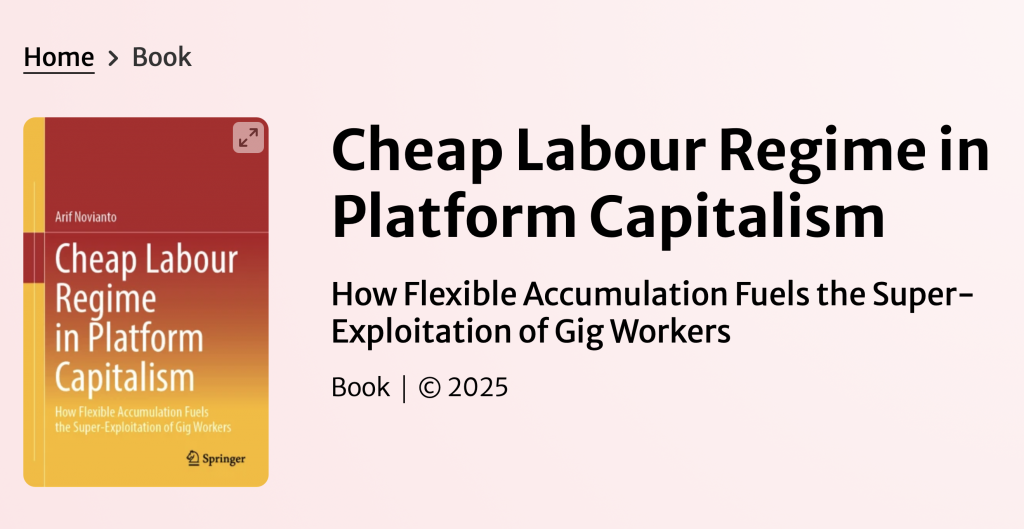
The AI Regime of Work advances the argument that algorithmic management and AI governance do not constitute merely new management techniques but a structurally coherent new regime of labour power — one whose material foundations were identified in Novianto’s (2025a) Cheap Labour Regime in Platform Capitalism. That book, drawing on Michael Burawoy’s (1985) labour regime theory, identifies five structural pillars of the cheap labour regime that together explain how super-exploitation is normalized and sustained in platform capitalism. These five pillars constitute the primary conceptual architecture of The AI Regime of Work and provide the organizing logic for its empirical chapters.
Together, these five pillars constitute what The AI Regime of Work theorizes as a qualitatively new regime of labour power — one in which the mechanisms of control (algorithmic management and AI) are articulated with the structural conditions of accumulation (labour oversupply, platform competition, state complicity, labour process engineering, and eroded bargaining power) to produce a stable, self-reproducing configuration of super-exploitation. The volume’s argument is that this configuration cannot be adequately theorized through frameworks developed for the factory floor, the formal employment relationship, or the first generation of digital labour platforms in the Global North — and that Indonesia, as one of the world’s largest and most politically contested gig economies, is the indispensable site for developing it.
Call for Chapters
The AI Regime of Work: Algorithmic Control and Precarious Labour in Indonesia’s Platform Economy (Springer Nature, February 2027), edited by Arif Novianto, seeks original chapters organized around the five structural pillars of the cheap labour regime and their interaction with algorithmic management and AI governance.
The volume is structured in THREE parts:
Parts I
Labour Processes, Algorithmic Discipline & Datafication
Part II
Precarity, Wages & Neoliberal Policy
Part III
Resistance, Alternatives & The Future of Work
Indicative themes include:
Gamification & algorithmic task allocation
The “mitra” classification & social protection gaps
Gendered & racialized dimensions of platform labour
Platform worker organizing & collective action
Cooperative & worker-led platform alternatives
Comparative regulatory frameworks across Southeast Asia
Methodologically diverse submissions (including original survey data, ethnographic fieldwork, legal-institutional analysis, and comparative approaches) are welcomed. The volume is positioned within critical political economy and labour studies traditions; submissions should reflect theoretical ambition alongside empirical rigour.
Submission Requirements
Extended abstract submissions (850–1,500 words) should include:
Abstract
Introduction (significance & contribution)
Theoretical Framework
Methods
Findings or anticipated argument
Brief CV
What Contributors Receive
Contributing a chapter to this volume comes with a set of concrete benefits — academic, material, and institutional — designed to support scholars across career stages, particularly those working in and on the Global South.
Free publication
English + Indonesian editions
2 printed copies per contributor
Scopus submission
Timeline
References
Aglietta, M. (1979). A theory of capitalist regulation: The US experience. New Left Books.
Anwar, M. A., & Graham, M. (2021). Between a rock and a hard place. Competition & Change, 25(2), 237–258.
Baiocco, S., et al. (2022). The algorithmic management of work and its implications. ILO–European Commission Background Paper No. 9.
Braverman, H. (1974). Labor and monopoly capital. Monthly Review Press.
Burawoy, M. (1985). The politics of production. Verso.
Faraoun, S. (2024). Theorizing labor in the platform economy. Sociology Compass, 18(11), e70018.
ILO. (2022). The algorithmic management of work and its implications. International Labour Organization.
Jarrahi, M. H., et al. (2021). Algorithmic management in a work context. Big Data & Society, 8(2).
Kellogg, K. C., Valentine, M. A., & Christin, A. (2020). Algorithms at work. Academy of Management Annals, 14(1), 366–410.
Lipietz, A. (1987). Mirages and miracles. Verso.
Novianto, A. (2025a). Cheap labour regime in platform capitalism. Springer Nature Singapore. https://doi.org/10.1007/978-981-95-1841-8
Novianto, A. (2025b). Gamification from below as a form of resistance. New Technology, Work and Employment. https://doi.org/10.1111/ntwe.12324
Taylor, F. W. (1911). The principles of scientific management. Harper & Brothers.
Törnberg, P. (2023). How platforms govern. Big Data & Society, 10(1).
Submit Extended Abstract
s.id/SubmitAIRegime
arifnovianto@untidar.ac.id · Universitas Tidar, Magelang
Publisher
Springer Nature
Indexing
Potentially Scopus indexed
Edition
English & Indonesian
Publication Fee
Free